New Berry Storage and Processing Research Facility in Place at NWREC
From an open, three-sided, gravel-bay storage and processing facility to a fully enclosed research structure with IQF processing and walk-in freezers, the North Willamette Research and Extension Center has dramatically improved its capacity to conduct post-harvest blueberry research.
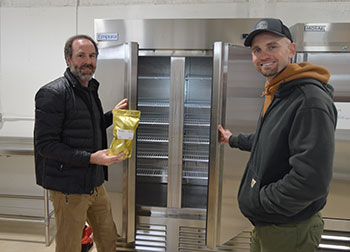 |
Scott Lukas, left, and Patrick Jones, a senior faculty research assistant, with a quick-blast freezing unit at the new berry storage and processing research facility at the North Willamette Research and Extension Center. |
“It is not what you would see in a large-scale commercial processing plant, because we don’t have the scale and the funds for that,” Oregon State University Extension berry research leader Scott Lukas said. “But it is a quick-blast freezing unit, so we can rapidly freeze fruit like IQF (individual quick freezing) processing. And now we have walk-in freezers and large-scale commercial freezers so we can hold that fruit and mimic as close as possible to what a commercial processing plant would do, but on a research scale.”
Funded largely with unrestricted research funds and royalty funds in Lukas’s accounts, with support from the USDA and the College of Agricultural Sciences, the new storage and processing facility is expected to be up and running in time for the 2026 harvests. It will be used for strawberries, blackberries, black and red raspberries and blueberries.
The project included assistance from the USDA berry breeding program, which helped purchase the freezers and is expected to use data from the facility in its breeding program. “Our process markets are 50 percent or more in blueberry,” Lukas said, “so, we need that IQF data to make decisions on the breeding materials.”
The need for the new facility was hastened by the fact that the OSU Food Science program discontinued its cooperation with the breeding program two years ago.
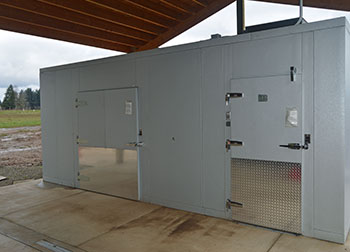 |
The walk-in refrigerator adjacent to the new berry storage and processing facility at NWREC is expected to assist blueberry breeding efforts for both fresh and processed berries. |
Siting the facility at the Aurora-based research center just made sense, Lukas said. “Having the breeding plots at NWREC, having the fruit up at NWREC, it just made sense that we have this facility here,” Lukas said.
Lukas noted that in addition to testing processed fruit, the new walk-in refrigerator could be used to test the storability of fresh-market berries. Ultimately, Lukas said he would like to bring in optical sorting equipment and other cutting-edge processing equipment. “The goal is to connect with some companies that have prototype units that can assess things like internal bruising, and get some really new technology in that facility, too,” he said.
Lukas, who not only largely funded the structure, but also designed it, said he had planned to use the unrestricted research funds for hiring students, postdoctoral researchers and other staff to help with his research projects. With this expenditure, he likely won’t be doing that anytime soon. But having the opportunity to work out of the new facility, to modernize the pre- and post-harvest work in his program, will help make up for that loss.
And the Oregon blueberry industry, as well as the strawberry, blackberry and raspberry industries, should benefit greatly.