With Scorch Virus, It’s Complicated
Blueberry fields with high levels of scorch virus can experience yield decline over time, and in some cases, growers should consider removing infected plants. In other cases, fields infected with scorch virus seemingly perform fine.
It is those dichotomous scenarios that complicate management approaches to a virus that lingered under the surface in Oregon for decades before being properly identified.
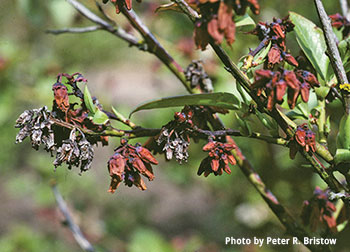
For years, according to Jason Myer of Northwest Berry Foundation, growers have mistook the viral disease for shock virus, a pollen transmitted disease commonly found in Oregon blueberry fields. Symptoms of the two diseases are nearly identical, Myer said.
 |
Jason Myer |
“Scorch symptoms can express very similar to shock symptoms, and I think that for us that has been a definite challenge,” Myer said.
Transmitted by aphids, scorch virus, unlike shock virus, causes recurring collapse symptoms, reduction of vigor and can lead to plant death.
There is no resistance to scorch virus in any known genetic plant material, but, Myer said, there is difference in viral expression symptoms among varieties.
“Some varieties seem to be much more tolerant,” he said. “They’ll carry the virus, they can spread the virus, but they may not show symptoms.”
With funding from the Oregon Blueberry Commission, ten of 101 samples tested positive for scorch in a 2025 survey of fields where growers were seeing symptoms of the virus. In fields with positive samples, 6 to 58 percent of the plants exhibited symptoms.
Fields that were tested ranged from 15 to 30 years old. In past years, Myer said, researchers have found scorch in fields as young as four or five years old.
Myer added that since 2018, one in four fields they have tested were positive for scorch.
 |
“Now, that isn’t to say we can expect that fields have a one-in-four chance of having scorch, because when we’re going out and sampling, we are sampling fields that have suspicious issues,” Myer said. “But it is still a pretty alarming rate.”
The virus has been found in fields throughout the Willamette Valley and going up the Columbia River. “This virus is well distributed,” he said. “It is not isolated to any one area.”
He added that less than 10 percent of Oregon blueberry farms have been tested for scorch, so it could be much more widespread. “We’d love to get a higher percentage tested before we can conclude definitely how widespread this is.”
As for managing the disease, Myer said there isn’t a lot a grower can do other than manage aphid populations and remove infected plants. He added that a grower can’t prune out the disease. Once a plant is infected, the virus will spread throughout the plant.
“It is not like you can just cut this out,” he said. “Half the plant might be showing symptoms. But that virus is moving throughout that plant. So, the only way to remove it is to remove the whole plant and destroy it.”
Like other questions surrounding this disease, the question of whether to replant fields infected with scorch virus is fraught with complications, Myer said. In some cases, infected fields hold up remarkably well over many years.
A draper field, for example, which has had scorch for several years, just recorded its highest yield ever in 2025, he said. “So, a grower looking at this field is going to say, ‘I’m not going to remove that. That’s still economically producing for me.’
“It is not like you can just cut this out. Half the plant might be showing symptoms. But that virus is moving throughout that plant. So, the only way to remove it is to remove the whole plant and destroy it.”
|
“So, there are a lot of different situations, and it just has to be evaluated on a case-by-case basis,” Myer said. “If you’re tracking a field and you’re seeing a steady decline, and maybe it’s a variety that is not really working in your program anyway, maybe that’s the time to pull it out. If it is economically productive, though, I mean, manage your aphids, but don’t take it out.”
As for whether to remove individual plants that are infected, that too is complicated, Myer said. “You should probably pull the plants if you can,” he said. “I wouldn’t spend a lot of money or time doing it, because we have seen that a lot of plants can be positive for scorch virus and be spreading that virus around but now showing any symptoms. So, if you’re just taking out the symptomatic plants, you’re not really removing a significant amount of that viral reservoir from your field environment.”
On the other hand, it can help to take out infected plants in poor health because it provides space for neighboring plants that are healthier to spread.
“This is why I think a lot of this yield decline is not something we’re fully seeing,” Myer said, “because as one plant is declining, that neighboring plant is like, ‘Oh, there’s more canopy area I can take over. There’s more root zone I can take over.’ And so it is not equating to one-plant down percentage wise when it comes to yield loss from the field.”
The bottom line, Myer said, is that infected fields can remain productive for a long time, and potentially a very long time. The bad news, however, is that plants that are symptomatic are unlikely to ever recover. “Once the virus is in the plant, it is always in the plant.”
Another good-news, bad-news scenario is that symptoms can disappear and reappear from year to year. “So, as long as they’re still healthy, they can return to a pretty productive state, even if in the long term they are still declining,” he said. The bad news, however, is that asymptomatic plants are still carriers, and maybe even a worse carrier than the symptomatic plants because they have a larger leaf-surface area that can support more aphids to vector the virus.
Keys to managing the disease, Myer said, are to catch it while at low levels and to manage for aphids. And, he said, it is important to sample suspicious plants to determine whether the disease is present.
May to June is the ideal sampling window, he said.