Grower Panel Addresses USHBC Proposed Assessment Increase
For Bryan Sakuma, the additional revenue expected to be generated from a proposed assessment increase for the U.S. Highbush Blueberry Council is needed to increase demand and stabilize pricing.
For Ellie Norris, the additional resources will help set up the industry for long-term success.
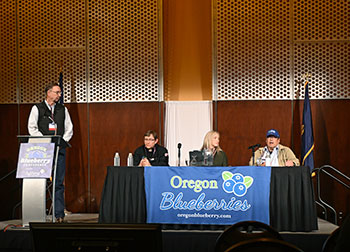 |
From left, moderator Tom Avinelis, Jeff Malensky, Ellie Norris and Bryan Sakuma during a panel discussion at the Oregon Blueberry Conference, February 3 in Salem. |
For Jeff Malensky the additional revenue will enable the USHBC to embrace opportunities to create additional value for each pound of blueberries.
A group of former and current USHBC Board members spoke in support of the council’s proposed assessment increase at the Oregon Blueberry Conference, February 3 in Salem.
The comments came during a panel discussion.
Sakuma, of Sakuma Farms and Processing in Burlington, Washington, who is the immediate past chair of the USHBC, said the proposal to increase the assessment from $18 to $36 a ton for fresh and from $18 to $30 a ton for processed blueberries came out of a steering committee recommendation in 2025.
The committee talked to grower groups from multiple regions in developing its recommendation over a year-long process and had hundreds of one-on-one conversations, Sakuma said.
The USHBC Board then voted to adopt the recommendation.
“So, currently, where we’re at is we’ve got the justification package ready to be submitted to the USDA, and what will happen is over the course of 18 to 24 months, the USDA and the Secretary of Agriculture will take a look at this information it, assess it, evaluate it and then at the end of that term, the Secretary of Agriculture will make the determination on whether to recommend going forward or not.” He added that the Secretary could also change the amount of the increase.
Sakuma said that if approved, the 2028 crop would be the first subjected to the increase. It will take another year before the USHBC will have an opportunity to spend the additional dollars.
“A lot of growers have done a lot of work to get us to this point in time,” Sakuma said, “and we feel comfortable that this is the right thing to do to try and increase demand and consumer consumption.
“With the increase in supply curve coming, we feel that it is imperative that we do this,” he said.
Norris, of Norris Blueberry Farms in Umpqua, Oregon, who was recently named chair of the USHBC, said she understands the concern aired by those opposed to the increase that the additional funding it generates will indiscriminately build markets for importers.
“The USHBC was initially designed to grow the entire blueberry category, not to manage supply, not to favor one region over another or favor one point of origin.”
|
“I understand that concern,” Norris said. “I cannot dismiss it. It is a tough time to be a grower in the United States. I myself feel the pressure of imports. I know many growers in this room do, as well. But it is important to step back and remember why the industry created the U.S. Highbush Blueberry Council 25 years ago. The USHBC was initially designed to grow the entire blueberry category, not to manage supply, not to favor one region over another or favor one point of origin.”
“So, at the end of the day, the USHBC exists to put more blueberries into shopping baskets more often, expand the demand in both the domestic and international markets and equip the industry with promotion, research and tools for long-term success,” Norris said. “This is about working together to build a bigger, more resilient market, so growers can have more opportunity.”
Malensky, of Oregon Berry Packing in Hillsboro, Oregon, added to Norris’s comments by pointing out that increasing blueberry consumption in the counter-seasonal markets ultimately benefits U.S. producers.
“This counter-seasonal does help us at the end of the day,” Malensky said. “It is showing benefits in driving that demand.”
Malensky, a current member and past chair of the USHBC’s Promotions Committee, said the professionalism exhibited by the current staff at the USHBC is unsurpassed and offers the industry a great opportunity to increase demand domestically and internationally.
“In Version 2, under (USHBC President) Kasey Cronquist’s leadership they’ve built out a much more robust program,” Malensky said. “I think we have a much greater opportunity than ever before to provide our community, our growers a great level of success.”