Best Practices for Machine Harvesting Fresh Market Blueberries
Wei Yang, Oregon State University – NWREC
Machine harvesting for the fresh blueberry market is becoming increasingly important as growers face labor challenges and rising production costs. Ensuring high fruit quality, however, requires careful coordination of harvesting technology, cultural practices, packing operations and cold chain management. This article summarizes current best practices aimed at reducing internal bruise damage (IBD) of fruits, improving packout, and successfully delivering mechanically harvested blueberries to the fresh market.
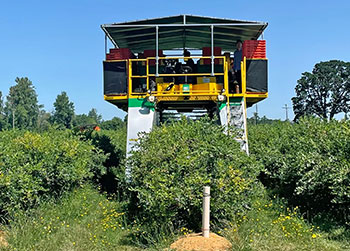 |
An OTR OXBO harvester harvesting blueberries for the fresh market in Jefferson Oregon. Note the shade canopy provides sun protection for harvested fruits. |
Modern over‑the‑row (OTR) harvesters have advanced significantly in recent years, particularly with the introduction of soft catch systems. These include padded conveyors and cushioned catch surfaces designed to absorb impact and reduce bruising, which is critical for reducing fruit IBD during mechanical harvesting. Both OXBO and Harvy500 harvesters now offer soft catch systems, which are standard on Harvy500 and optional on OXBO. These soft catch systems require proper maintenance and care during harvest to ensure their continued effectiveness. Beyond catch surfaces, machine settings play a critical role in fruit quality. Beater settings must be adjusted to match cultivar characteristics, fruit maturity, and plant architecture. Too much shaking leads to fruit bruising and loss of immature fruit, while too little results in poor harvest efficiency. Recent field trials with the OXBO 7450 equipped with AutoFill demonstrated that ground speed and head RPM significantly affect postharvest fruit condition. Higher ground speeds reduced firmness and increased IBD, while higher beater RPM improved firmness, reduced bruising, and harvested more mature berries with higher berry weight and soluble solids.
Successful machine harvest for fresh market operation starts at dormant pruning. Growers can support successful mechanization by shaping the plant canopy through targeted cultural practices. Narrowing the crown of the bush through early training and pruning helps keep fruit within the harvester’s catch zone and prevents losses to the ground. Directional pruning, a technique that encourages branches to grow outward rather than inward, reduces fruit drop distance onto the catch surface, minimizes bruising, and enhances harvest efficiency. Annual pruning to remove inward‑facing fruiting woods and open dense canopy areas improves both machine access and overall plant health. A recent field evaluation showed that as much as one‑third of harvested fruit fell into the center of the row, illustrating the significant influence of canopy structure on fruit retention during machine harvest.
Harvest temperature also has a major impact on fruit quality. Blueberries picked at high temperatures, particularly above 77°F, are softer, more vulnerable to bruising, and more prone to rapid postharvest deterioration. High field temperatures make it much longer to remove field heat inside the fruit during forced-air cooling, increasing the likelihood of fruit internal damage during storage. To mitigate these risks, growers are encouraged to harvest early in the morning when fruit temperatures are low, ideally below 70°F, or to consider nighttime harvesting. Many growers discontinue harvesting when temperatures exceed 80–85°F because quality declines rapidly beyond this point.
Once fruit arrives at the packing facility, gentle handling becomes critical. Machine‑harvested blueberries are more susceptible to bruising and contamination with leaves and stems, making advanced sorting and careful conveyance essential. Optical sorting systems using near‑infrared imaging and machine‑learning algorithms can identify both external and internal defects, helping to keep substandard fruit from entering fresh market channels. Meanwhile, packing lines should be designed to minimize impact by incorporating cushioned chutes, soft‑drop mechanisms, and low‑impact conveyors. Reducing the number of fruit transfers and providing staff training on gentle handling practices further preserves fruit integrity. Fruit dumping using a robotic or automated tipping system can improve gentle handling and increase efficiency when transferring berries onto the packing line. Clamshell filling should be performed with equipment designed to minimize compression and drop height, and all packing operations should take place in a temperature‑controlled environment below 55°F to prevent fruit warming and maintain postharvest quality.
Cold chain management is the final and perhaps most critical component in maintaining blueberry quality from field to consumer. Machine‑harvested fruit should be cooled to 32–34°F within four to six hours after harvest using forced‑air cooling systems, with refrigerated field trucks or trailers strongly recommended to prevent temperature spikes. Once cooled, fruit should be stored at high relative humidity (90–95%) to maintain firmness and prevent moisture loss. Packaging materials must allow sufficient airflow, and temperature should be carefully monitored throughout distribution. Even brief interruptions in the cold chain can accelerate fruit IBD development, softening, and decay, reducing both shelf life and marketability.
In summary, the success of machine harvesting for fresh blueberries depends on an integrated approach that spans production practices, harvester operation, postharvest handling, and temperature management in the field and cold storage. Implementing advanced harvesting technologies, maintaining proper pruning and training systems, adopting gentle packing procedures, and ensuring a seamless cold chain all contribute to high fruit quality and reduced postharvest losses. Continued collaboration among growers, equipment manufacturers, researchers, and packing facilities will be essential to refining these practices and supporting the long‑term success of machine‑harvested fruit in the fresh blueberry market.