NABC Presentation Highlights Farm Bill, Labor Concerns
The unfinished Farm Bill and labor issues highlight concerns addressed by the North American Blueberry Council on Capitol Hill, according to a presentation from Senior Director of Government Affairs and Public Policy Alyssa Houtby.
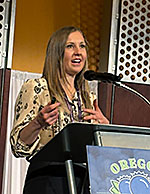 |
Brian Bocock |
Speaking at the 2026 Oregon Blueberry Conference, Houtby said the NABC also is working to ensure blueberries are prominently featured in school nutrition programs through influencing Make America Healthy Again dietary guidelines.
“We are working to position blueberries as a solution to the challenges the MAHA agenda has identified,” Houtby said.
And the council is working to improve blueberry crop insurance and the tree-assistance program, a program that reimburses up to 65 percent of the cost to replant fields after a disaster, as well as elicit additional funding for agricultural export market development programs.
The NABC serves as the industry’s voluntary advocacy association and manages operations for the U.S. Highbush Blueberry Council.
On the international front, the NABC is working to address tariff and non-tariff barriers in foreign markets, including in Japan and Vietnam, and to open markets in New Zealand and Australia, two countries that deny access to fresh blueberries from the U.S.
“Those are the two biggest outstanding markets that we have for access for fresh blueberries,” Houtby said. “Australia is a bit challenging, but we do see a pathway forward in New Zealand. They are actively working on our pest-risk assessment, and they will actually be in Oregon for the U.S.-New Zealand Health Bilateral Meeting and will be doing a site visit to blueberries as part of our market access.”
“I don’t want to promise anything,” she added. “Market access takes a long time. We’ve had both Australia and New Zealand access requests outstanding for over a decade, but we are hopeful that we’ll see some great momentum following that site visit and potentially have access into New Zealand by the end of the year.”
In regard to Japan and Vietnam, the NABC is trying to get tariffs reduced on blueberries. In South Korea, the council is trying to improve market access for fresh blueberries.
“You here in Oregon have access for fresh blueberries into South Korea, but it’s been about 10-plus years in the making trying to get expanded access for California and Washington state,” she said.
She added that South Korean officials will be visiting blueberry facilities in California in April. “So, finally after many, many years of no progress, we are seeing progress,” she said.
As for labor concerns, Houtby noted that the U.S. Department of Labor announced an interim final rule at the end of last year that changed how the adverse effect wage rate is calculated in the H-2A program. The change resulted in about a $3 per hour decrease in wage rates in most states, she said.
“I think in Oregon, that reduction was not as great, but one thing that was very helpful was a housing credit,” she said.
She noted the NABC is helping the Department of Justice defend the rule against a lawsuit filed by United Farm Workers and is working to with Congress to codify the rule.
“The second there is a different administration with a different philosophy on wage rates, that rule changes and we can be back to square one with wage rates on an annual escalation,” she said. “We don’t want to see that happen and the only way to prevent that is by codifying the rule into law.”
As for the Farm Bill, which she called “the Farm Bill that will never actually happen,” the council is working to establish a permanent disaster structure and permanent economic aid structure at USDA. “So, in the future, when Congress does appropriations funding for those types of programs, the structure is there,” she said. “It doesn’t change with each round of ad hoc assistance. It is permanent, it’s simple to use and it delivers actual meaningful assistance to growers.”